Pulsed Neutron Generators
Models: All
All of Adelphi's neutron generators can be pulsed. In Adelphi's neutron generators pulsing is achieved by pulsing the RF source that drives the neutron generator's Electron Cyclotron Resonance (ECR) ion source. Pulsing can be used as part of time-of-flight experiments, and the speed of the neutrons is therefore important.
In Adelphi's neutron generators, the RF source can be instructed to pulse, or it can be supplied with a digital signal (such as TTL/5V, 3.3V) to command the RF source 'ON'. The minimum RF pulse the RF sources natively produce is 4 microseconds long. There is a very large range of pulse lengths and duty factors that are possible.
The minimum pulse length of our higher yield generators can provide is 4 microseconds FWHM and the the maximum pulse length is the tube lifetime for sealed generators or is dictated by the size of your deuterium bottle for actively pumped, 'open' systems, and can be several months. The lowest pulse frequency we've tested is 1 Hz, the upper limit is dictated by the pulse length, so 100 kHz should be straightforward.
Some examples of neutron pulse measurements are given below using Adelphi's standard products.
- 230 microsecond FWHM neutron pulses at a pulse repetition rate of 1 kHz (period = 1ms) 230us 1kHz (.xlsx file)
- 4.5 microseconds FWHM neutron pulses at a pulse repetition rate of 1 kHz (period = 1ms) 4.5us 1kHz (.xlsx file)
- 92 microsecond FWHM neutron pulses at a pulse repetition rate of 1 Hz (period 1 s) 92us 1Hz (.xlsx file)
- 3 microsecond FWHM neutron pulses at a pulse repetition rate of 1 Hz (period 1 second)3us 1Hz (.xlsx file)
Adelphi is also developing neutron generators that have improved neutron pulse characteristics, with the focus of that development being fast pulse fall-off. Example pulse and duty factor results are shown below:
- 100 microseconds, 1kHz (period 1ms)
The D-T reaction produces 14 MeV neutrons, this corresponds to neutrons with a speed of 5.12×10⁷ m/s. Expressed another way, this is 5.12 cm/ns (or 51.2 m/microsecond). These neutrons ARE traveling at 17% of the speed of light in a vacuum. 2.45 MeV neutrons from the D-D reaction travel at 2.16 cm/ns and thermal neutrons with energy 0.025eV (=kT where k is Boltzman's constant and T is the temperature, 300K) travel at 2.19 km/s.
The speed of the neutron as a function of energy is shown in the graph below. This graph is calculated using the reletivistic equation of the kinetic energy (KE), KE=(γ-1).m0.c2 where KE is the Kinetic Energy of the neutron, γ (gamma) is the Lorentz factor, γ = 1 / √(1 - v2 / c2), m0 is the rest-mass of the neutron (1.68×10⁻²⁷kg), v is the speed (in meters per second) of the neutron in the laboratory frame of reference, and c is the speed of light.
This is summarized in the table below for 'fast' (2.45 MeV and 14.1 MeV) neutrons and 'thermal' (0.025eV) neutrons :
- 14 MeV neutrons, v= 5.12×10⁷ m/s = 5.12 cm/ns = 51.2 m/us (17% c)
- 2.45 MeV neutrons, v= 2.16×10⁷ m/s = 2.16 cm/ns = 21.61 m/us (7% c)
- 0.025eV neutrons, v= 2.19×10³ m/s = 2.19 km/s (0.00073% c)
- light, v= 299,792,458 m/s = 29.98 cm/ns (100% c)
A comparison is given with light, which moves at 299,792,458 m/s = 29.98 cm/ns (leading to the well known rule-of thumb that light travels at "1 foot a nanosecond", since 30.48cm = 1 foot). These speeds were calculated, accounting for relativistic effects (since the neutron is moving at 17% of the speed of light in the case of 14.1 MeV neutrons). If instead, the non-relativistic formula for the kinetic energy is used, KE=½m0v2, then the result is 5.195×10⁷ m/s for 14.1 MeV neutrons and 2.16×10⁷ m/s for 2.45 MeV. This is only a difference of 1.3% for 14.1 MeV neutrons, and less than 0.1% for 2.45 MeV neutrons. So, the non-relativistic treatment is good enough for most applications.
Higher energy neutrons, which undergo collisions with other atoms in a material (a moderator), loose energy upon each collision. The smaller the mass of the moderator nucleus (which is the closer-to the mass of the neutron), the more energy is transferred from the neutron to the moderator. After severl collisions the neutron eventually 'thermalizes' and ends up having the same energy as the moderator atoms, so kT where k is Boltzman's constnt and T is the temperature in Kelvin, this is 0.025 eV. The figure shows the graph of neutron (and moderator nucleus) energy following each collision as a function of moderator nucleus mass. Hydrogen (mass 2 amu), carbon (mass 12 amu) and oxygen (mass 16 amu) are typically used for moderation. Hydrogen and carbon are key constituents of High Density Polyethylene (C2H4)n, and Hydrogen and oxygen are the constituents of water (H2O). Both of these materials are commonly use as a moderator. After approximately 20 collisions water, a 14.1 MeV neutron will be thermalized, this process typically takes around 5 microseocnds in water and about 40 microseconds in carbon (graphite). For this reason, when measuring pulses of neutrons, it is important to use detectors that can differentiate between fast neutrons from thermal neutrons, or are only sensitive to fast neutrons.
Pulsed neutrons have a few applications, such as
- Imaging, allowing an image to be produced with varying amounts of thermalization
- Geological analysis, fast neutrons thermalize and captured by hydrogen atoms in water, when captured they emit a characteristic 2.2 MeV gamma ray that can be detected. Time of flight gives the distance to the water source
- Detector calibration for experiments such as the search for dark matter
- Security applications, techniques such as Differential Die Away Analysis (DDAA) can be used to identify nuclear materials
- Fuel analysis, pulsed neutron sources can be used to monitor nuclear fuel enrichment levels using a pulsed subcritical assembly approach
For time-of-flight measurements, it is typically desirable to have very short pulses separated by a long durtion, such as 5us at 1kHz. For DDAA measurements it is typically useful to have fast neutron pulse fall-off because signals persist following the switching-off of the neutron source. The data below shows Adelphi's typical neutron generator pulsed response. We additionally have new sources capable of much faster pulse fall-off than from our standard product line.
Useful Spreadsheets
Images

Neutron speed
Calculated neutron speed based on the relativistic equation for kinetic energy
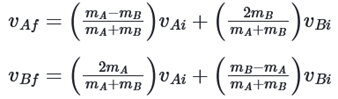
Elastic collisions formula
Equations to calculate the energy transfer between a neutron and a moderator nucleus based on conservation of momentum
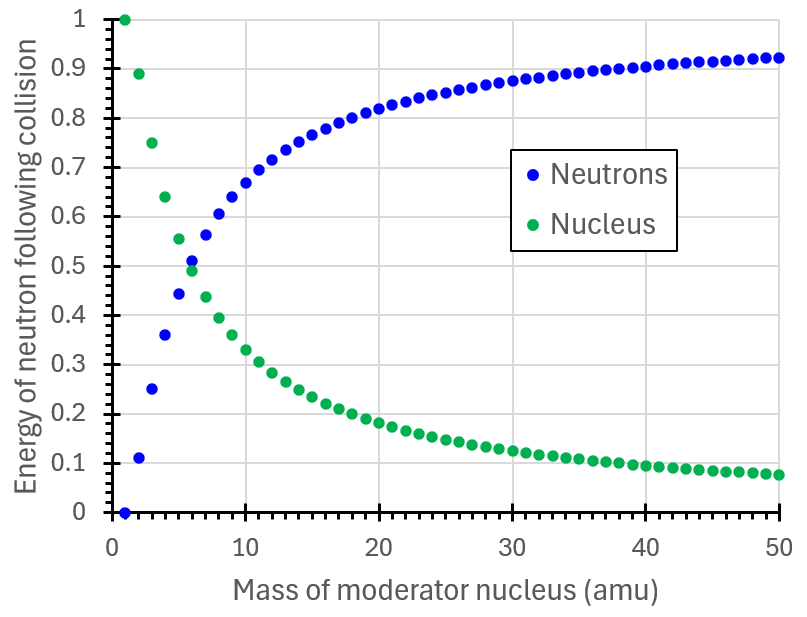
Energy transfer
Energy transfer between a nuutron and a moderator nucleus upon collision
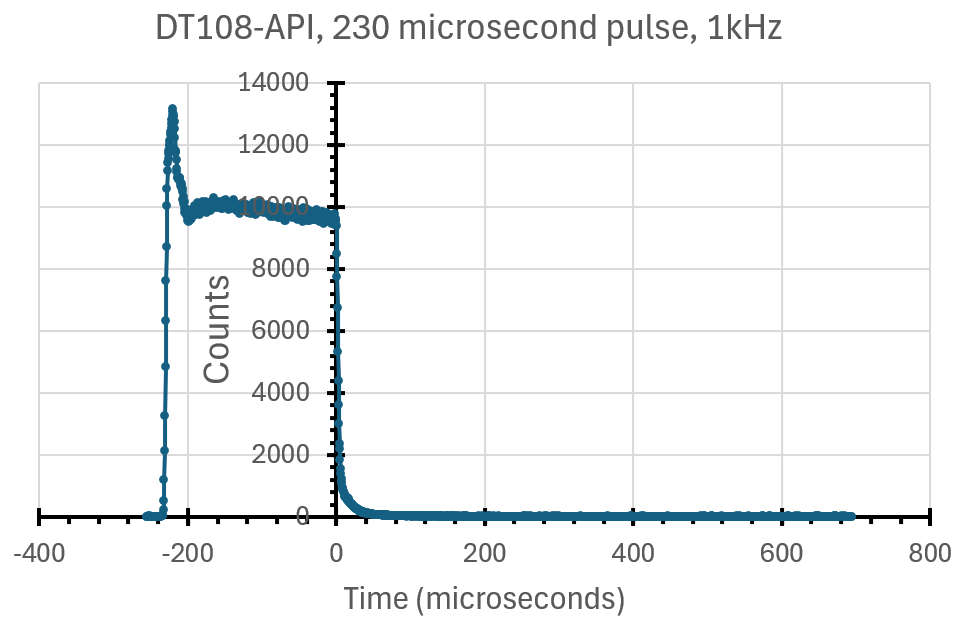
Pulsing: 230us, 1 kHz
Neutron pulse: 230 microseconds, pulse repetition rate 1 kHz
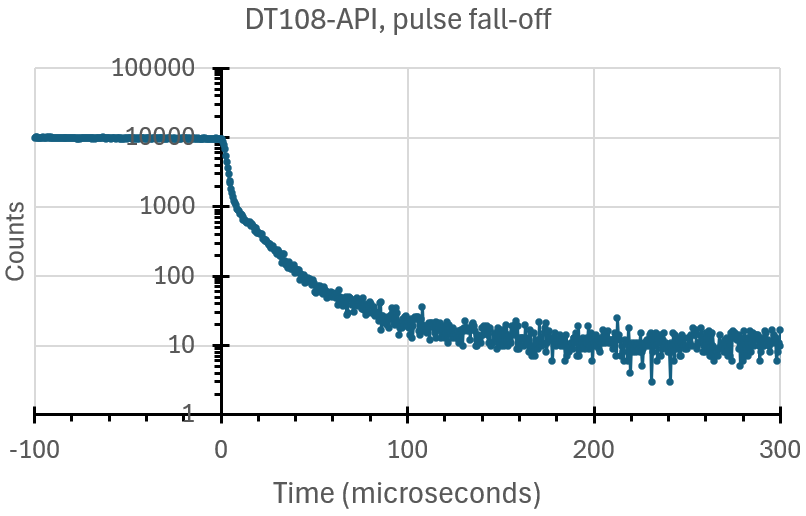
Pulse fall-off: 230us, 1 kHz
Pulse fall-off for Neutron pulse: 230 microseconds, pulse repetition rate 1 kHz

3.5 microsecond, 1 Hz
Short pulses (3.5 microseconds FWHM) separated by 1 second

90 microsecond, 1 Hz
Short pulses (3.5 microseconds FWHM) separated by 1 second